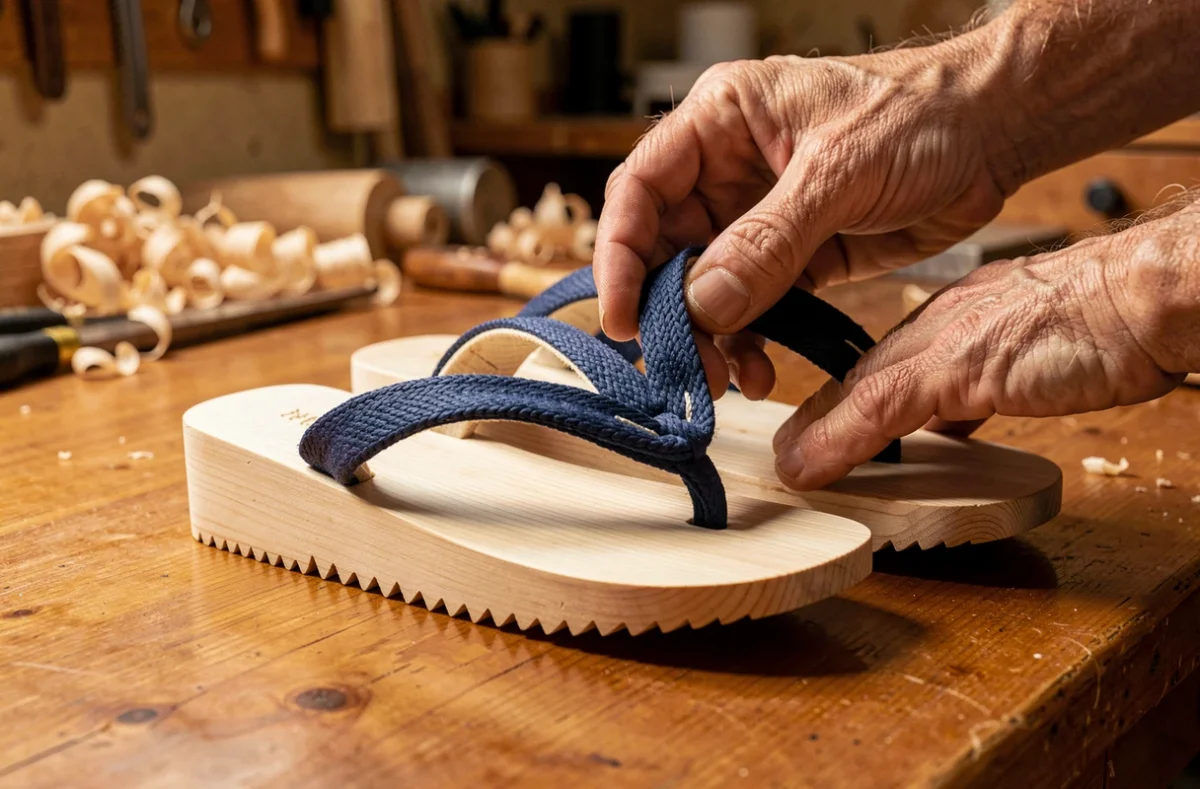
The distinction between a handcrafted geta and an industrial copy is not determined by the label. It is verified at the level of the shaping chain, the choice of raw wood, and the method of assembling the hanao. Recognizing quality Japanese handcrafted geta requires knowing how to read the structure of the sandal itself.
Division of labor in Japanese geta workshops: who shapes what
A quality handcrafted geta is not necessarily the work of a single artisan. Traditional manufacturing relies on a division of labor among several specialists: one workshop shapes the dai, another drills the holes for the hanao, and a third assembles and adjusts the strap. This organization has existed for a long time in Japanese workshops, and it is not a sign of mass production.
The gradual disappearance of these specialized workshops complicates traceability. A manufacturer like Mizutori, based in Shizuoka, precisely documents this task distribution. We recommend checking if the product sheet clearly identifies who shapes the dai, drills the holes, and assembles the hanao. A brand that does not detail this production chain does not provide enough elements to judge the authenticity of the craftsmanship.
To obtain more information about Kabanes, we advise cross-referencing the manufacturer’s indications with the structural criteria detailed below.
Kiri and wood grain: identifying the quality of the dai through visual inspection
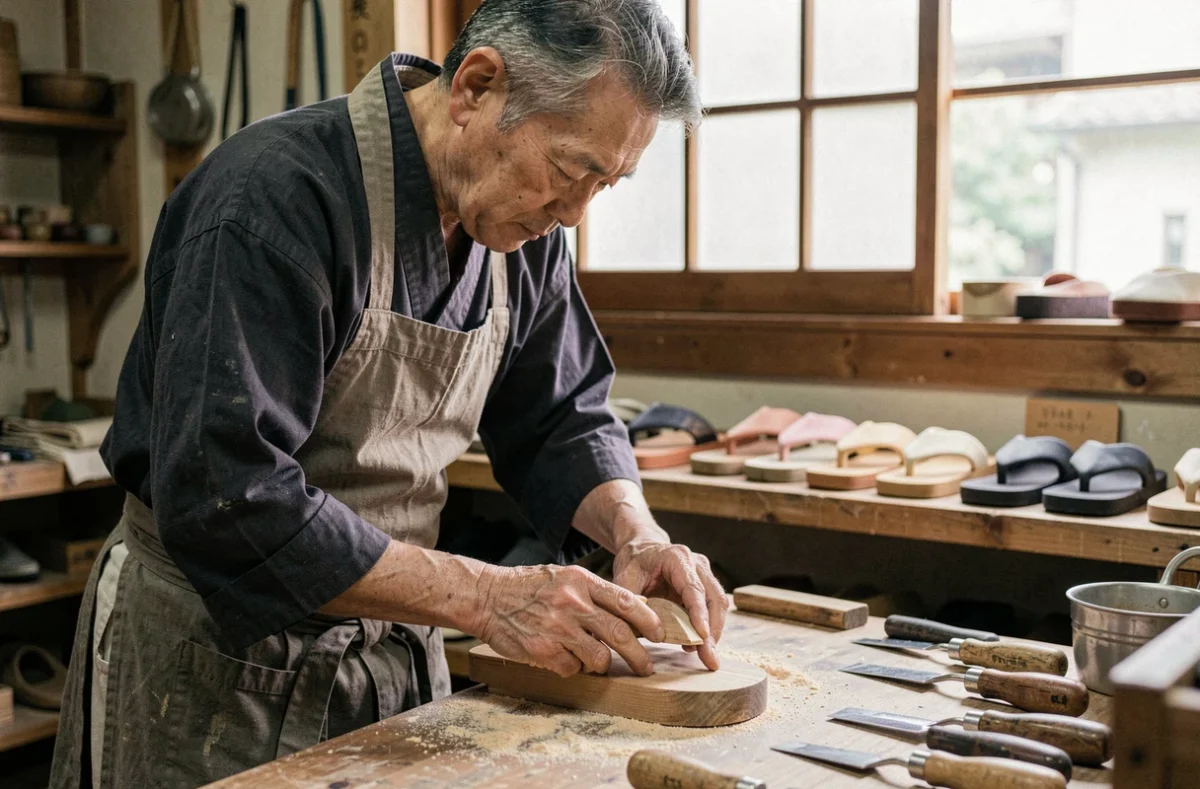
The reference wood remains kiri (paulownia). Its lightness and natural resistance to moisture make it the historical material for Japanese geta. A kiri dai has a fine grain, a cream-white hue, and a weight significantly lower than that of an unidentified generic wood.
Turn the sandal over. On a handcrafted piece, the ha are carved from the same block of wood as the dai. If the teeth are glued, screwed, or fixed with added dowels, the product is industrial or semi-industrial. This structural test is the quickest and most reliable.
The surface of the dai also deserves careful examination. An artisan leaves light planing marks, a lively texture, and sometimes fine surface irregularities. A perfectly uniform and smooth sanding across the sole betrays mechanical machining. We observe that some manufacturers apply a thick varnish to mask poor-quality wood: an authentic kiri dai often appears raw or protected by a very discreet finish.
Handcrafted hanao: stitching, materials, and strap tension
The hanao is the second quality marker to check. On a Japanese handcrafted geta, the strap is hand-stitched with a twisted internal cord. The stitching should be regular without being mechanically perfect. A stitch that is too uniform, with no variation in tension, indicates machine production.
The outer fabric of the hanao also provides clues. Traditional workshops use woven cotton, sometimes silk or chirimen velvet. The quality of the inner padding varies: handcrafted models often incorporate tightly packed cotton that maintains the shape of the strap over time, whereas industrial copies use synthetic foam that flattens quickly.
Three points to check on the hanao:
- The knot under the dai must be handmade, with a cord passing through the sole via three distinct holes (one at the front, two at the back)
- The tension of the strap must withstand moderate pulling without slipping into the hole of the dai, indicating a tight fit during assembly
- The outer fabric should not show visible heat sealing on the edges, a common production shortcut on low-end models
Contemporary adaptations and Japanese geta: comfort versus strict authenticity
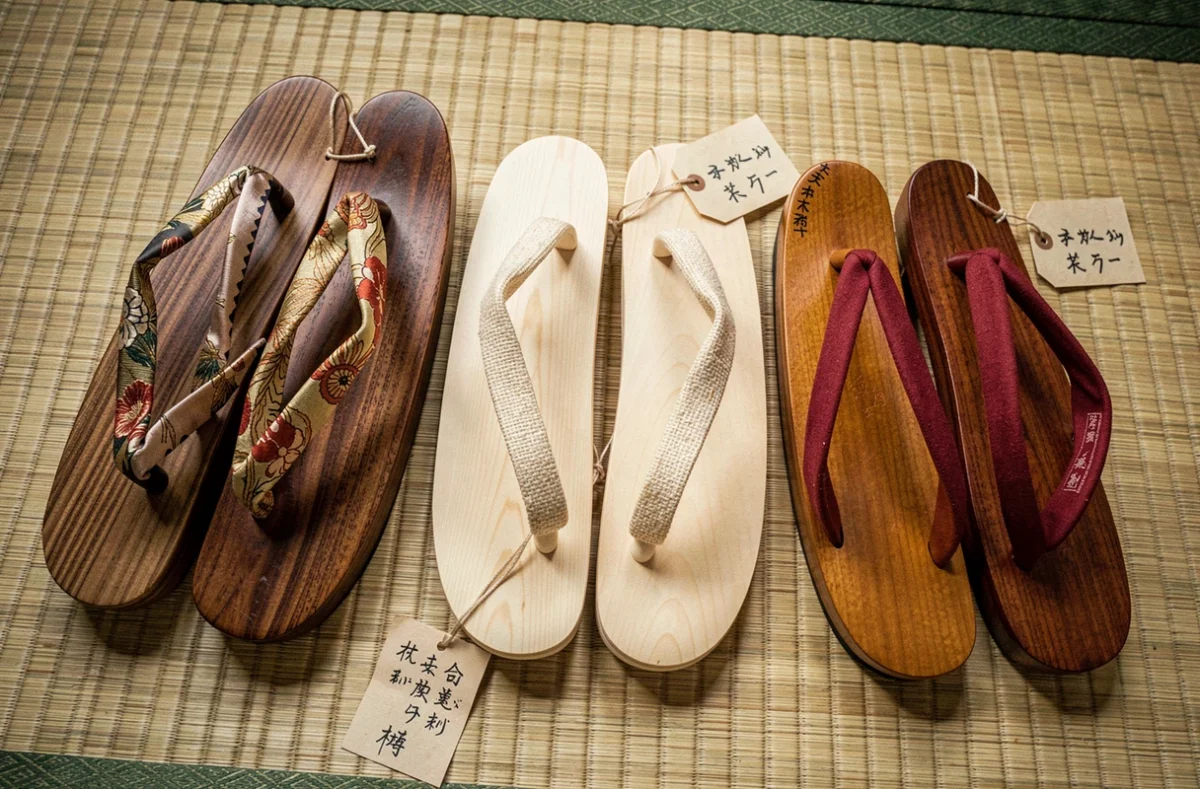
Some Japanese manufacturers are now developing three-dimensional sculpted soles and padded straps to improve the distribution of plantar pressures. These innovations are not traditional in the historical sense. They represent a contemporary biomechanical adaptation aimed at reducing friction and facilitating prolonged wear.
We believe that these adaptations do not automatically disqualify the artisanal quality of a geta. The determining criterion remains the shaping of the dai and the method of assembly. An anatomical sole sculpted from a block of kiri by an artisan from Shizuoka constitutes a handcrafted product, even if its shape differs from a classic Edo model.
In contrast, a geta presented as traditional but featuring a composite wood sole with a rubber insert falls under the category of hybrid products. The manufacturer’s transparency regarding the materials and processes used remains the best filter.
Criteria to check before purchasing a handcrafted geta
Here are the concrete elements to verify to distinguish a Japanese handcrafted production from an industrial one:
- The monobloc dai with ha carved from the mass, without visible assembly or screws
- The identification of the wood used (kiri, hinoki, sugi) and its consistency with the observed weight and grain
- The mention of the workshops responsible for shaping, drilling, and assembling the hanao
- The absence of thick varnish or plastic coating on the sole
- A price consistent with the time of artisanal work: an authentic handcrafted geta does not sell for the price of a mass-produced sandal
The market for Japanese wooden sandals blurs the lines between true craftsmanship and mechanized production dressed in traditional discourse. Careful reading of the product’s structure, combined with a demand for traceability in the manufacturing chain, remains the safest method for making an informed choice.