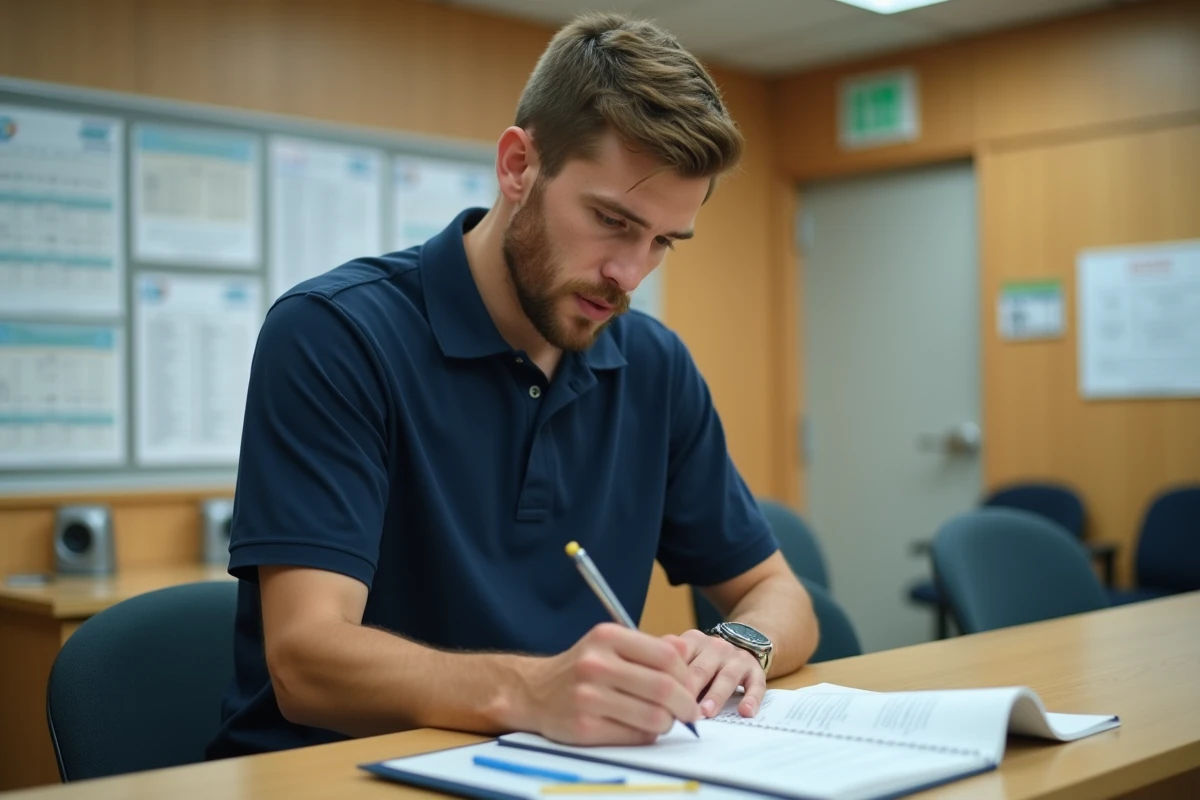
A 35-year-old employee transitioning to industrial maintenance, a 42-year-old mother aiming for a vocational baccalaureate after years of non-graduate experience: these profiles exist, and the question of the age limit for entering a vocational baccalaureate comes up every school year. The answer depends less on a single number than on the status chosen to pursue the training.
School status, apprenticeship, or continuing education: each path has its own age rules
The age limit for the vocational baccalaureate is often confused with that of apprenticeship. These are two distinct subjects. The classic school status in a vocational high school primarily targets students leaving middle school, generally between 15 and 18 years old. National texts do not set a strict maximum age for entering initial training under school status, but in practice, public high schools rarely accept adults over 20 in this track.
Since the 2024 school year, several academies are testing bridge programs for those over 20 wishing to prepare for a vocational baccalaureate in public high schools, with schedules condensed over three to four days and enhanced support. The Lyon academy is part of the pilot territories. These programs remain experimental and do not cover all specialties.
To better understand the duration of the vocational baccalaureate on Apprendissimo, we see that the standard path spans three years after middle school, but direct entry into the first year of vocational training exists for holders of a CAP or another diploma, which shortens the training.
In apprenticeship (through a CFA), the current limit is set at 29 years old at the time of signing the contract. This rule comes from the Labor Code, articles L.6222-2 and L.6211-2. Beyond this age, one transitions to continuing education for adults, funded by other mechanisms.

Exceptions after 29 years: who can still sign an apprenticeship contract
The barrier of 29 years is not as rigid as it seems. The Labor Code provides for several cases where apprenticeship remains open beyond this limit.
- Individuals with a recognition of the status of disabled worker (RQTH) have no age limit for entering apprenticeship.
- Candidates with a project to create or take over a business requiring the targeted diploma can exceed the limit.
- High-level athletes listed on ministerial lists benefit from the same exemption.
- Former holders of a commitment contract in the armed forces can also qualify.
These exemptions allow candidates over 30 to enter a vocational baccalaureate through the apprenticeship route. In practice, one must provide proof to the CFA and the employer before signing the contract. The GRETA or the academic information and orientation service (SAIO) of each academy can guide you to the right contact.
When continuing education takes over
For adults who do not fall under any exemption, continuing education imposes no age limit. One prepares for the vocational baccalaureate in a GRETA, a private training organization, or via CNAM, with funding through the CPF, an employer’s skills development plan, or regional aid.
The path can last less than three years if the VAE (validation of acquired experience) allows for the validation of certain skill blocks in advance. Feedback on this point varies according to juries and specialties, but the principle remains the same: each validated block reduces the remaining training duration.
Vocational baccalaureate as a free candidate: a little-known option with no age restrictions
One can present for the vocational baccalaureate as a free candidate, without going through a school or a CFA. This modality imposes no age or prior diploma conditions. Registration is done directly with the rectorate of one’s academy, via the EduConnect or FranceConnect portal depending on the academies.
In practice, the free candidate must justify periods of training in a professional environment (PFMP), unless they can prove sufficient professional experience in the targeted sector. This is the most delicate point: without a host company, finding an internship location often becomes a challenging task when one is over 25 or 30 years old.
Preparing for the exam alone: what it entails
The free candidate takes all the exams in their punctual form (no continuous assessment). Therefore, one must master both general subjects and technical professional exams, without the framework of an institution. Some candidates combine a job in the sector with distance preparation through organizations like CNED.

Concrete steps based on your age and situation
The choice of the right system depends on three variables: age, current professional status, and targeted specialty. Here are the most common combinations.
- Under 20, without a diploma: registration in the second year of vocational training via the classic academic allocation procedure (Affelnet). This is the standard three-year path.
- Between 16 and 29, with an employer willing to sign: apprenticeship contract in CFA. Entry into the first year of vocational training is possible with a CAP from the same professional field.
- Over 29 without exemption: continuing education (GRETA, accredited organization) or free candidate. The CPF covers part of the costs in most cases.
- Disabled worker, regardless of age: apprenticeship without limit, with adapted support from the CFA.
Checking registration dates remains the first step. For free candidates, registrations at the rectorate typically occur between October and December for the following June session. For apprenticeship, the search for an employer should ideally start several months before the school year begins.
The vocational baccalaureate remains one of the most accessible diplomas in the French education system, precisely because access routes are multiplying. The real constraint is not age itself, but the ability to find the right status and the right funding to complete the training.