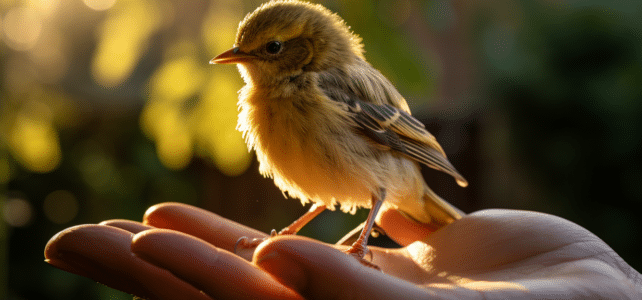
Spring, the season of births, sometimes offers surprises in our gardens. A fledgling that has fallen from its nest, frail and vulnerable, can awaken a surge of compassion in each of us. Discovering such a small creature often sparks an immediate desire to help. However, good intentions are not enough. It is important to know the appropriate actions to maximize the fledgling’s chances of survival. The urgency is to determine the course of action, considering that each action can significantly influence the animal’s future.
Assessment and first aid for a found fledgling
When you find a fledgling stranded in your garden, a quick assessment of its condition is crucial. Observe if the animal shows any signs of distress: weakness, ruffled feathers, lack of reaction to stimuli, or visible injuries. A baby sparrow, for example, may be more resilient than it appears, but remains fragile and requires special attention. First and foremost, check if the fledgling can return to its nest by itself or if human intervention is justified.
Be aware that some species are protected and retrieving a fledgling may be illegal without knowing the applicable regulations. A WARNING is in order: consult the relevant authorities before proceeding with any form of rescue. The priority remains to ensure the bird’s well-being while respecting the law.
The first aid focuses on creating a safe and warm environment for the fledgling. A box lined with fabric without loops, preventing small fingers or toes from getting caught, will serve as an artificial nest. Temperature is a critical factor: maintain warmth using a hot water bottle or a heating lamp, ensuring not to overheat the animal.
Hygiene remains an essential aspect of care. Handle the fledgling with clean hands and sterilized instruments to minimize the risk of disease transmission. First aid should include hydration, with drops of room temperature water if the fledgling is able to drink without choking. Take precautions not to force-feed or water, as this can be fatal.
Long-term care and release of the fledgling
Once first aid has been provided, the question of long-term care for the fledgling arises. Rescue centers and specialized organizations such as the League for the Protection of Birds (LPO) offer fundamental support in this regard. Your role is to stabilize the fledgling’s condition before entrusting it to expert hands capable of ensuring its development and reintroduction into its natural environment.
Building an adequate habitat is essential for the young bird. The fledgling requires an environment that closely mimics its natural habitat, thereby facilitating its learning of essential survival behaviors. The LPO and other wildlife rehabilitation centers provide valuable advice to prepare the fledgling for its future return to nature.
Regarding feeding, the food must be carefully selected. Feeding methods vary depending on the species and age of the fledgling. Specific preparations, such as rearing mash, can be used to ensure the bird receives all the necessary nutrients. Hydration also remains a critical aspect of the care process and must be carried out carefully to avoid any risk of aspiration.
The release of the fledgling is the ultimate goal of any care provided. This delicate moment must be carefully planned to coincide with a favorable period, generally when the bird has reached a sufficient level of independence and environmental conditions are suitable. Specialists at wildlife rescue centers are trained to assess the optimal moment and execute the release, thus ensuring the best chances of survival for the bird in its natural environment.